How Industrial Drones Are Enhancing Data Collection and Cybersecurity
A few years ago, inspecting a transmission tower or a half-built high-rise meant sending someone up there with a harness and a camera. Now it’s a fifteen-minute flight. That shift gets talked about constantly in terms of speed and cost, but there’s a quieter side to it that doesn’t come up as often: every one of those flights is now a data event, and most companies haven’t really sat down and asked where that data goes, who touches it, and what happens if it ends up somewhere it shouldn’t.
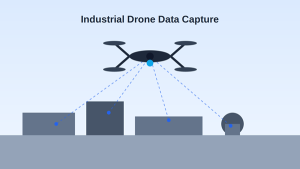 Industrial drones now capture inspection, survey, and monitoring data across sites that were previously reached only on foot.
Where Industrial Drones Are Actually Changing Data Collection
You can see the pattern most clearly in three places:
- Utilities and energy: thermal and visual inspection of transmission lines, substations, and solar arrays, largely replacing helicopter flyovers and manual line crews.
- Construction and infrastructure: photogrammetry and LiDAR sweeps that turn a job site into a measurable 3D model on a weekly basis, so progress gets tracked against plan instead of guessed at.
- Agriculture and land management: multispectral imagery that flags irrigation problems or pest pressure days before anyone would notice it walking the field.
What’s actually changed in the last couple of years isn’t the flying itself, it’s how much data comes back from each flight. A single mapping run over a mid-sized facility can produce tens of gigabytes of imagery, sensor readings, and telemetry in one afternoon. That data usually makes three separate hops: from the drone’s onboard storage, to a ground control station, then up to a cloud platform for processing. Each of those hops is a place where something can go wrong.
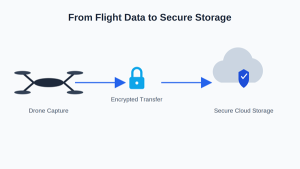 Every handoff between drone, ground station, and cloud storage is a point where flight and sensor data needs to be protected.
The Cybersecurity Problem Nobody Budgets For
Drone programs almost always get funded as an operations expense, hardware, pilots, flight planning software, and security gets bolted on afterward, if it gets addressed at all. A few reasons that’s worth fixing:
- Flight data often includes facility layouts, security camera blind spots, pipeline routes, or other site details that are genuinely sensitive if they leak.
- Enterprise platforms such as DJI Enterprise, Skydio, Parrot ANAFI AI, Autel Enterprise and similar systems now include significantly stronger security capabilities and their companion apps have had documented firmware and data-handling issues, and a lot of fleets are still running outdated firmware without anyone tracking it.
- Ground control links and telemetry can be intercepted or spoofed when they’re not encrypted, a bigger deal for critical infrastructure than most operators initially assume.
- Cloud storage for imagery and mapping outputs tends to get set up by the operations team, not IT, so access controls and encryption-at-rest end up inconsistent from one project to the next.
None of this means drones are especially dangerous. It means they’ve quietly become another endpoint on the network, and most industrial security programs were built before that endpoint existed. Following established guidance such as the NIST Framework can help organizations manage these risks more systematically.
Beyond the NIST Cybersecurity Framework, organisations operating industrial drone programmes should also be aware of other recognised security standards and regulatory requirements. Frameworks such as ISO/IEC 27001 for information security management, the NIS2 Directive within the European Union, and aviation guidance published by authorities such as the FAA and the UK Civil Aviation Authority (CAA) all contribute to strengthening the governance and protection of drone-collected data. Aligning drone operations with these recognised best practices helps organisations reduce risk while building greater trust with clients and stakeholders.
A Scenario Worth Thinking Through
Picture a mid-sized utility running weekly drone inspections on a substation network. The pilot’s laptop syncs flight footage to a shared drive every Friday, nobody remembers setting that up, it’s just how it’s always worked. That shared drive has broader access than it should, and the footage includes clear shots of access points, camera placement, and equipment layout. Nothing malicious has to happen for this to be a problem: a contractor with drive access changes jobs, a laptop gets lost, a link gets shared one step too widely. None of that requires a sophisticated attacker. It just requires nobody having looked at the data flow end-to-end.
That’s the pattern in most drone-related exposure, it’s rarely a dramatic hack. It’s an unreviewed workflow that quietly accumulated risk over a year of otherwise normal operations.
What a Reasonable Security Baseline Looks Like
- Treat drone hardware and companion software like any other IoT endpoint, known firmware versions, a patch schedule, and an actual inventory of what’s in the fleet.
- Encrypt data in transit between drone, ground station, and cloud, and encrypt it at rest once it lands in storage.
- Keep drone network traffic separate from core operational networks where possible, so a compromised drone link isn’t a direct path into production systems.
- Apply role-based access to flight data and mapping outputs, not everyone who wants the imagery needs the raw, unprocessed sensor data.
- Fold drone and imaging platforms explicitly into incident response planning instead of letting them sit under a vague ‘IT assets’ umbrella.
Most industrial teams don’t have this expertise sitting in-house, and honestly, it’s not fair to expect an ops or facilities team to also own network security architecture on top of everything else they’re running. Working with a firm that specializes in cybersecurity support is a practical way to get drone data pipelines, ground stations, and cloud storage assessed and hardened without pulling that responsibility away from the people actually flying the missions.
 Securing drone-collected data means treating flight platforms as part of the broader network, not a separate system.
Getting Started Without Overhauling Everything
None of this requires ripping out an existing drone program and starting over. The teams that handle it well usually start small: map out exactly where flight data goes today, from capture to final storage, and flag the handoffs nobody’s reviewed in a while. That alone tends to surface two or three quick fixes, a shared drive with too much access, firmware that hasn’t been touched in over a year, a telemetry link running unencrypted because it was never flagged. Fix those first. The bigger architectural decisions, like network segmentation or a formal vendor review, can follow once the obvious gaps are closed.
Where This Is Heading
The next phase of industrial drone adoption isn’t really about flight capability anymore, that part’s largely solved. It’s about what happens to the data after the drone lands. Operators who treat their drone program as a data pipeline with real security requirements, rather than just a flying camera, are the ones who’ll be able to scale it across sites without quietly building up a liability along the way.
Conclusion
Drones have earned their place in industrial data collection, that part isn’t really in question anymore. What’s still catching up is the security thinking around them. The operators who come out ahead won’t necessarily be the ones with the most advanced fleets; they’ll be the ones who asked the less exciting question early: where does this data actually go, who can see it, and is it protected the same way the rest of the network is. That’s a far more manageable problem to solve before an incident forces the issue than after.
As industrial drone operations continue to expand, organisations that combine operational excellence with strong cybersecurity practices will be best positioned to unlock the full value of drone technology while protecting their critical data assets.
Clients selecting professional drone operators should also consider cybersecurity practices alongside flying skills.